
“'Music gives a soul to the universe, wings to the mind, flight to the imagination and life to everything ".
Plato
Department Vision Statement/ Curriculum Intent
In September 2020 the music department introduced a brand-new curriculum, based around the principles of Musical Future’s Just Play.
This is centred around the strands of a typical music education; Listening and Appraising, Composing and Performing, but with a focus on developing core instrumental skills on ukulele, guitar and keyboard. Pupils are then able to utilise these skills when exploring different genres of music and composing their own pieces. Learning comes through practical exploration first, with every lesson having practical music making at its core. From September 2026 all Year 7 pupils will have two lessons of Music a fortnight, doubling their curriculum time. One lesson will follow the traditional curriculum focused on developing music knowledge and instrumental skills. The other lesson will be focused on developing strong vocal skills, building on the singing done at primary school. They will then be introduced to Music technology later on in the year.
The strands of rhythm, melody and harmony run through the curriculum at key stage three. Pupils begin by exploring rhythm through body percussion and rhythmic composing tasks. They then move onto focusing on melody, learning about the role of the right hand on the keyboard. This is followed by a unit on the ukulele, learning about chords as well as developing instrumental skills, giving them a foundation in harmony.
These strands are revisited in year 8 and 9 and help pupils to understand the building blocks of all music.
As well as these fundamental music skills, pupils also develop a range of transferable skills within their music lessons. They develop their confidence as musicians and are giving opportunities to perform if they choose to. Pupils are taught how to give positive feedback, helping to nurture a safe environment and one which is supportive, aiming to put even the most nervous performers at ease. Through this they gain a sense of achievement and the skills needed to evaluate themselves and their music constructively. Music naturally requires a great amount of perseverance and resilience, and this is something that pupils learn throughout key stage three as they develop their instrumental skills. Within composing tasks pupils work as part of a team, learning to cooperate and to be creative together. They learn about leadership and collaboration. Through listening tasks pupils learn about the context of different genres of music and develop an appreciation of different musical styles.
As pupils move into key stage 4 they may want to carry on with their music education. Here they continue to develop their skills as musicians, but at a more advanced level. The vocational course prepares them for a possible career in music, but expands many of the transferable skills from key stage three.
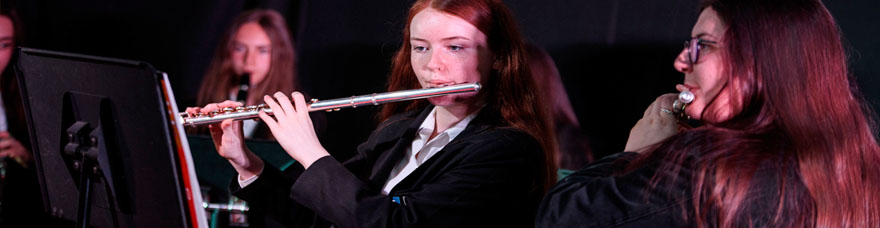
Pupils are given the opportunity to extend their musical learning through a wide range of extra-curricular activities which support the work taking place in the classroom. This includes lunchtime and after school clubs, trips, concerts and instrumental lessons. We have a fantastic team of peripatetic music staff able to teach a variety of instruments. All are professional musicians as well as teachers and so offer an insight into life as a musician.
Music Tuition?
Click here to view our instrumental lessons
YEAR GROUPS
year 7 - ks3
| TERM |
TOPIC |
RESOURCES |
|
1
|
Introduction to Music Rhythm
Pupils explore rhythm through a range of practical activities including whole class music making and group composition tasks using body percussion and percussion instruments. They learn about the percussion family using a range of untuned instruments. They are introduced to the four basic note values and learn to recognise these. The chance to perform their group piece to the class introduces pupils to performing and helps them learn simple feedback and appraisal skills.
Introduction to Find Your Voice
Pupils will learn the fundamentals of healthy singing, including posture, breathing, vocal warm-ups, diction, pitch matching and vocal care. They will explore how the voice works and develop an understanding of how good technique supports vocal performance. Throughout the unit, pupils will be encouraged to sing safely and confidently within their vocal range.
|
Curriculum Booklet
Homework Booklet |
|
2
|
Instrumental Skills 1 – Keyboard focus Melody
Pupils learn basic keyboard skills focused on the right hand initially. This includes exploring the functions of the keyboard such as changing the voice, adding a beat and more advanced features. They learn the basic five-finger hand position and how to find the letters on the keyboard. Using a range of keyboard tuition resources pupils can learn at their own pace, exploring a variety of pieces. They are introduced to simple music notation.
Find Your Voice
Pupils will continue to learn the fundamentals of healthy singing, including posture, breathing, vocal warm-ups, diction, pitch matching and vocal care. They will explore how the voice works and develop an understanding of how good technique supports vocal performance. Throughout the unit, pupils will be encouraged to sing safely and confidently within their vocal range.
|
Curriculum Booklet
Homework Booklet |
|
3 & 4
|
Instrumental Skills 2 – Ukulele focus Harmony
Pupils are introduced to the ukulele and to the concept of chords. They begin with learning two chords, building on these each lesson allowing them to play a range of different repertoire.
Pupils learn how to read chord diagrams and to interpret these, preparing them for future learning when they may choose to play guitar or bass guitar.
They learn about basic chord theory, the difference between major and minor chords and experience playing as a class with a focus on timing and awareness of their own part within the ensemble.
Find Your Voice
Pupils will continue to learn the fundamentals of healthy singing, including posture, breathing, vocal warm-ups, diction, pitch matching and vocal care. They will explore how the voice works and develop an understanding of how good technique supports vocal performance. Throughout the unit, pupils will be encouraged to sing safely and confidently within their vocal range.
|
Curriculum Booklet
Homework Booklet |
|
5
|
The Orchestra
Pupils explore Beethoven’s Ode to Joy through listening activities and practical tasks. They learn about the instruments typically found in an orchestra, about the layout of the orchestra and the role of the conductor.
Each lesson focuses on a different instrumental family, building on their knowledge from Term 1 where they were introduced to the Percussion family.
Pupils learn the melody line for Ode to Joy, on the keyboard, revisiting their keyboard skills from Term 2. As a class they learn to play the piece together, learning about the role of the conductor and how they keep the orchestra in time. Some pupils will move on to learn the harmony line for the piece, or add in a percussion part, creating a sense of what playing in an orchestra is like.
|
Curriculum Booklet
Homework Booklet |
|
6
|
The Carnival of the Animals
Pupils explore some of the pieces from Saints-Saens musical suite through listening and appraisal activities. They compose their own piece of music based on an animal of their choice, using the elements of music to enhance their work. They evaluate their own work and share their pieces with the class. They combine their knowledge and understanding from the previous units to create their pieces, composing melodies and adding harmonic and rhythmic parts.
|
Curriculum Booklet
Homework Booklet |
Year 8 - KS3
| TERM |
TOPIC |
RESOURCES |
|
1
|
Instrumental Skills 3 – Keyboard focus Harmony
Pupils are introduced to the role of the left hand on the keyboard and learn how to play a range of major and minor chords.
This builds on their knowledge from Year 7 Keyboard Skills and Ukulele skills.
They play a range of pieces using the Learn To Play resources from Musical Futures.
Pupils will play as a class, revisiting and developing their ensemble playing skills.
|
Curriculum Booklet
Homework Booklet
|
|
2
|
Instrumental Skills 4 - Keyboard focus Melody and Harmony
Pupils select a piece from a range of options to focus on. They begin by learning how to play the melody line of the piece, ensuring they can play with a sense of fluency.
They then add in the left-hand part, using root note chords initially and then expanding these to triads.
They work with independence to learn the piece at their own pace, demonstrating the skills they have learnt over year 7 and 8 so far.
|
Curriculum Booklet
Homework Booklet
|
|
3
|
Film Music Part 1 Sound Effects
Pupils learn about how and why music is included in films. They learn about diegetic and non-diegetic music, as well as the role of the Foley artist. Working in groups they create the sound effects for a short film clip, focusing on selecting the best sound and ensuring their timing is accurate.
|
Curriculum Booklet
Homework Booklet
|
|
4
|
Film Music Part 2 Music to build tension
Pupils learn about the role of music to create atmosphere in films, developing their understanding of well-known film scores such as Jaws and Lord of the Rings. They use keyboards and other instruments to compose music to add atmosphere to the film clip, learning about chromatic notes, as well as major, minor and diminished chords to help build tension.
|
Curriculum Booklet
Homework Booklet
|
|
5
|
Just Play Introduction Band Skills
This unit begins with Chair drumming to teach the elements of the drum kit and to revisit the work from Year 7 around rhythm. This is then used to build knowledge of the rhythm section of a band, looking at the roles of the bass guitar and rhythm guitar. Pupils are then introduced to the instruments they can choose from for Just Play – keyboard, ukulele, guitar and bass guitar. They use the lessons this term to try out a variety of instruments, learning about how they are played and how to understand the chord diagrams. They build on their ensemble playing skills from Year 7 and 8, playing pieces at the same time.
Introduction to Music Technology
Pupils will learn how computers can be used to create music. They will be introduced to a DAW (digital audio workstation) as a tool for producing and composing music.
Pupils will learn about loops and how pre-existing loops can be manipulated to create music. They will learn about layering, and the role of the rhythmic, harmonic and melodic lines.
|
Curriculum Booklet
Homework Booklet |
|
6
|
Just Play Part 1
Pupils select which instrument they wish to focus on and stick to the chosen instrument for the whole term. Working as a class they learn basic skills on their chosen instrument, including simplified chords, rhythmic patterns and develop their ability to play as part of an ensemble. There are opportunities for pupils to take on the role of the drummer, or as singers, to complete the class band.
Each lesson builds on the previous lesson, introducing new chords and expanding the repertoire available to play.
Introduction to Music Technology
Pupils will learn how computers can be used to create music. They will be introduced to a DAW (digital audio workstation) as a tool for producing and composing music.
They will learn how to use a Patterns Beatmaker to make their own drum beat.
Pupils will learn how to use a MIDI keyboard, exploring how to play and record their own music into the DAW and then how to manipulate it.
|
Curriculum Booklet
Homework Booklet
|
Year 9 - KS3
| TERM |
TOPIC |
RESOURCES |
|
1 & 2
|
Instrumental Skills Ukulele/Guitar/Keyboard focus
Just Play Part 2
Using the skills learnt in the previous term, pupils develop their knowledge of chords and improve their playing technique on their chosen instrument. They build on their chord knowledge, learning new chords each lesson. They explore a range of repertoire, working towards a class performance of Last Christmas
|
Curriculum Booklet
Homework Booklet
|
|
3
|
Reggae
Pupils are introduced to Reggae as a genre of music. They learn about the history and background to Reggae, learning about where in the world it comes from and the musical features of the style.
Pupils begin learning Three Little Birds, starting with the chord sequence and rhythm parts. They are introduced to the keyboard and bass guitar riffs and learn about how these fit within the song. This is then developed each lesson, building towards a class performance of the song. Some classes will then extend their learning further by exploring other Reggae songs such as One Love.
|
Curriculum Booklet
Homework Booklet
|
|
4 & 5
|
Song Writing Part 1
Pupils learn about song structure and how songs are created through a range of listening tasks. They explore rhyming patterns and learn how lyrics are written through creating their own parody song. They begin to write lyrics for their own song, working as individuals or in small group.
Pupils then work to create music for their song, beginning with composing their own chord sequence before adding in the vocal melody line. They will learn about riffs from popular music, composing their own riff to go in their song. They will learn about the conventions of the middle 8, intro and outro, creating these to complete their song. Homework tasks focus on the music industry, providing pupils with the opportunity to learn about the role of agents, producers, managers and the importance of copyright.
|
Curriculum Booklet
Homework Booklet
|
|
6
|
Just Play Part 3
Using the skills learnt in the previous terms, pupils continue to expand their knowledge of chords and to explore new repertoire. They learn about extended chords, such as 7th and sus4 chords, and develop their understanding of how these chords are created.
They learn more complex pieces, incorporating more challenging chord sequences and strumming patterns.
|
Curriculum Booklet
Homework Booklet
|
yEAR 10 - ks4 (BTEC Tech Award in Music Practice)
| YEAR |
TOPIC |
RESOURCES |
|
10
|
Course Introduction
Pupils take part in a range of practical activities to introduce them to the course and each other. This includes rehearsing a piece as a class ensemble, learning about their instrumental skills and ability to play effectively as a group. They learn the keywords required for the course and complete a wide range of listening activities to further develop their understanding of these.They are also introduced to SoundTrap as a DAW, learning about how to use loops, record in music and manipulate samples.
Component 1 – House (EDM) Music, Minimalism, British Invasion, Delta Blues and Film Music
Pupils spend the majority of this year exploring different genres of music. For each genre they learn about its historical context and origins, typical musical features and musicians associated with the style. They complete research tasks and listening activities as well as practical exploration of each style. All pupils will produce, compose and perform music applying their knowledge about the different styles to their practical work, linked to a word provided by the exam board.
Using everything they have learnt, pupils then submit a piece of coursework that incorporates their acquired knowledge as well as their practical exploration and case studies, using PowerPoint to complete the written tasks as well as embed their musical examples.
|
Curriculum Booklet
Homework Booklet
|
|
11
|
Component 2 Developing Skills
Pupils learn about the roles of performer, composer and producer within the music industry. They explore what each role involves and the skills required. They then choose to focus on two of these areas for this component. For each area they carry out a skills audit, identifying their strengths and areas for development. They set themselves SMART targets and devise an action plan to set out how they will demonstrate developing their skills. Pupils then work towards a performance, finished composition or arrangement that shows how they have developed their skills and is clearly linked to the brief provided by the exam board. Along the way they collect evidence at milestone points and evaluate their progress.
Component 3 Responding to a Brief
This is the externally assessed element of the course. Pupils select a piece of music and a style of music from the exam brief provided. They begin by learning their chosen piece and understanding how it is constructed. Through a range of workshop lessons they explore the musical features of the different styles on the brief. They then work to change their chosen piece into the chosen style. Once completed they record their finished piece. Alongside this they write about their plans and ideas, demonstrating their understanding of their chosen style, explaining the process of how they created the piece and evaluating the finished product through a range of milestone reports.
|
Curriculum Booklet
Homework Booklet
|